

20
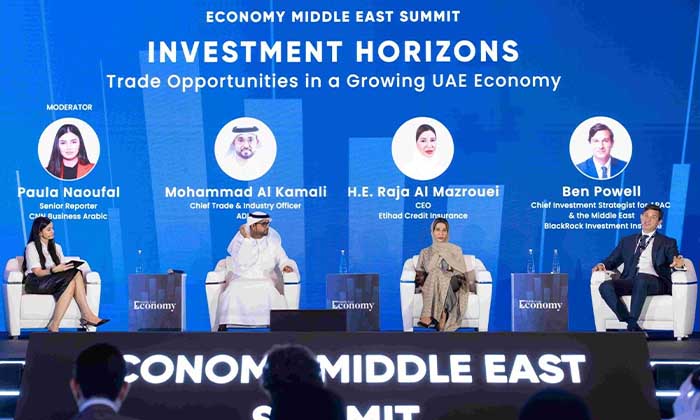
H.E. Raja Al Mazrouei, Chief Executive Officer of Etihad Credit Insurance (ECI), underscored the critical role of export credit agencies in safeguarding trade continuity and strengthening the UAE’s non-oil economy amid rising geopolitical uncertainty and evolving global trade dynamics during Economy Middle East Summit 2026, where ECI participated as a sponsor.
Her Excellency Raja participated in a panel titled “Investment Horizons: Trade Opportunities in a Growing UAE Economy” at the summit, where she was also recognized in the “Empowering UAE Businesses in Global Markets” category for her leadership in advancing the UAE’s trade and export ecosystem.
During the discussion, H.E. Raja highlighted how the global trade environment is undergoing a profound transformation driven by supply chain fragmentation, elevated shipping risks, rising insurance costs, and shifting geopolitical realities. The current geopolitical uncertainty is no longer an occasional disruption – it has become part of the operating environment for international trade. In this environment, the role of export credit agencies like ECI has become significantly more strategic than traditional risk coverage. Thus, reinforcing ECI’s commitment and mandate to enable trade continuity, despite volatility.
H
E. highlighted that despite mounting pressures across global insurance and trade markets, ECI has maintained a balanced approach focused on supporting UAE exporters while preserving market stability. Rather than implementing blanket premium increases, ECI has expanded its exposure appetite and provided greater flexibility around payment terms to help businesses manage liquidity pressures during uncertain periods.
The company further enhanced its underwriting agility, and strengthened real-<a href="https://menainsights.com/its-game-time-lets-go-score-big-with-lgs-tv-and-soundbar-systems-and-bring-the-stadium-home/”>time risk monitoring systems, to help businesses maintain liquidity and sustain growth.
SMEs remain a key priority for ECI, given their growing contribution to the UAE’s non-oil export sector and their heightened vulnerability during periods of volatility. At the same time, ECI is directing greater attention toward future-focused sectors such as surveillance, emerging infrastructure, and advanced industries where export support can create a multiplier effect on national competitiveness.
The panel shed light on how ECI identifies emerging opportunities for UAE exporters, explaining that the organization’s market intelligence framework goes beyond traditional economic indicators and focuses on the intersection of demand momentum, trade enablement, and risk resilience.
The discussion underscored ECI’s close tracking of rising non-oil trade in sectors where the UAE is strongest—advanced manufacturing, logistics, healthcare, food security, clean energy, and industrial technologies. It also highlighted that the We the UAE 2031 vision is creating major opportunities for exporters in productivity, sustainability, and future-oriented innovation.
ECI works closely with local and international financial institutions, export credit agencies, and strategic partners to strengthen trade finance ecosystems across emerging corridors. Through its insurance and guarantee solutions, ECI enables exporters to secure working capital, access trade financing, and offer more competitive payment terms.
H.E. Raja concluded by reaffirming ECI’s broader mission as a strategic growth partner for UAE exporters, supporting UAE businesses to become more competitive globally, scale exports sustainably, and fully capitalize on the opportunities being created through the UAE’s expanding global trade network and CEPAs.