

15
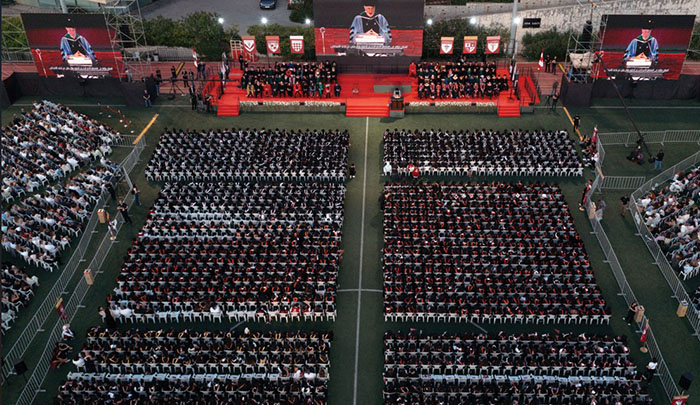
The American University of Beirut (AUB) celebrated the achievements of 1,470 undergraduates, conferring their degrees on the second day of its 157th commencement—a class that reached this moment through some of the most demanding years in the region’s recent history. AUB President Fadlo Khuri delivered the commencement address, undergraduate student speaker Carmen Bonja addressed her classmates, and AUB honorary doctorate recipient Dr. M. Amin Arnaout gave the keynote.
In his address, President Khuri reflected on the turbulent years the Class of 2026 had weathered and on what he hoped they would take from them—not only knowledge, but qualities of empathy and forgiveness, and the willingness to genuinely listen to and consider a perspective different from one’s own. He reminded graduates that for the last eleven years since he assumed his role, the university had adhered strictly to the principles of academic freedom, allowing the broadest possible scope of discourse and diversity of opinion while debating the salient issues of the day.
To bring the idea home, Khuri did what the AUB community had long known him to do—reached for an unexpected metaphor, this time the life and music of American singer-songwriter John Prine. He recounted how Prine, after deep personal hardship, answered heartbreak not with resentment but with grace. From that, Khuri drew a lesson he said he had watched the graduates live out: “You too have learned that when it really matters, you, like Prine, can have ‘no hate and no pride’.”
Khuri closed on the enduring bond between graduates and their university
“The ties that bind you to one another and to AUB, your alma mater, are tensile and strong,” he said—urging them to stay close not only to friends, but, when possible, even “with those you came into conflict with.”
Undergraduate student speaker Carmen Bonja, who graduated with degrees in nursing and psychology, built her address around a single word: abundance. She recalled the moment that met her at the very start of her time at AUB, when the February 2023 earthquake in Aleppo took her father and her home, just as she began her first semester —and the support the university gave her in response. “AUB became a place of abundance,” she said. “It gave me steadiness, when I was unsteady. It gave me dignity, when grief made me feel small.” Drawing on AUB’s founding motto—”That they may have life and have it more abundantly”—she urged her classmates to pass that gift forward: “That is abundance. Not what we receive, but what we become capable of giving.”
Keynote speaker Dr. M. Amin Arnaout, professor of medicine at Harvard Medical School and an AUB graduate, offered the class two reflections—one on the gown they wore, one on a starfish. He traced the academic gown’s origins to the scholarly attire of Al-Qarawiyyin in Morocco, regarded as the world’s oldest continuously operating university. He described a cross-cultural heritage that links today’s graduates to centuries of learning. “The gown you wear connects you to this part of your rich heritage,” he said.
His second image came from science. More than a century ago, Arnaout recounted, Nobel laureate Élie Metchnikoff watched specialized cells inside a starfish larva converge from all directions to fend off a threat—the same defensive process, at least 500 million years old, that protects the human body today. The lesson, he suggested, was one of unity: “Even cells without brains act together, sacrificing themselves for the common goal of protecting the host. Perhaps we, as people equipped with reason, a shared genome, and common culture, can learn from our cells to set aside petty differences and unite for the shared goal of ensuring our collective survival and prosperity.” He left the graduates with a wish: “May expanding knowledge, wisdom, purposeful strength, inclusion, and justice inspire you to rise, honor your shared past, build a brighter future, and transform the world for the better, for all.”
As the ceremony drew to a close, the Class of 2026 left with their student speaker’s call still in the air—to ripple the abundance they found at AUB outward, and to open doors for others as theirs had been opened.