

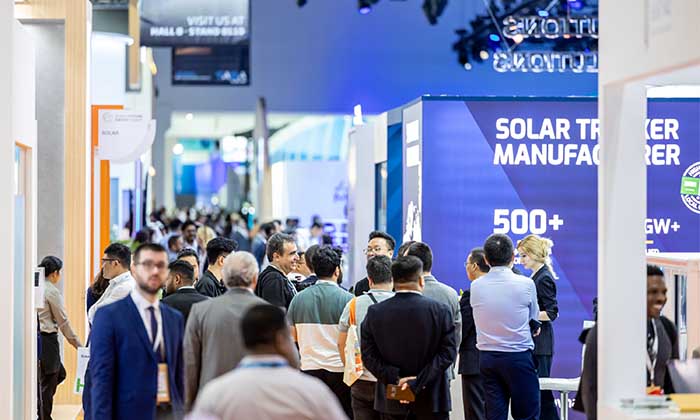
The World Future Energy Summit 2026, hosted by Masdar and part of Abu Dhabi Sustainability Week, will address key economic and geopolitical challenges facing the rapidly expanding solar-energy industry.
Taking place at Abu Dhabi National Exhibition Centre (ADNEC) from January 13–15, the Summit’s Solar and Clean Energy Conference and Exhibition will explore groundbreaking technologies and strategies, convening thought leaders, policymakers, and innovators to refine solar energy management across the Middle East and North Africa (MENA).
In 2024, global solar power installations soared to 597 gigawatts, representing a 33 per cent surge over the previous year. This has pushed global capacity to more than 2 terawatts (TW), according to SolarPower Europe’s latest Global Market Outlook. The report forecasts that solar installations could reach a remarkable 1 TW annually by 2030, making it the strongest asset globally in the battle against climate change.
The solar energy sector is also expanding rapidly across the MENA region, with installed capacity rising by 23 per cent in 2023 to reach 32 gigawatts peak (GWp). According to the 2025 MESIA Solar Outlook Report, that figure is expected to surpass 180 GWp by 2030, driven by initiatives like the Dubai Clean Energy Strategy 2050 and Abu Dhabi Vision 2030, which aim to aim to produce 75 per cent of energy requirements from clean sources by 2050 and 30 per cent by 2030, respectively.
Speaking at the conference on monetising stranded renewables into revenue streams is Nicolás Bohrer, Puroil’s Managing Director. His session will explore how dynamic, switchable off-takers, from bitcoin miners to adaptable data centres could turn surplus electrons into steady revenue.
“As solar capacity keeps soaring, the real challenge is no longer generation, but integration. The region has a unique opportunity to demonstrate how abundant solar production can be aligned with real-time demand while preserving system reliability at scale,” said Bohrer.
“With strong institutions and a clear appetite for innovation, MENA is well positioned to act as a proving ground for the next phase of renewable integration. By prioritising adaptability and system balance alongside continued expansion, the region can help define how solar energy is integrated into modern power systems worldwide. The question is no longer whether solar can scale, but how intelligently energy systems adapt when it does,” he added.
A Platform for Technical Innovation
To meet such ambitious targets, companies in the region must adopt digital, scalable solutions that manage increasingly complex portfolios, ensure operational efficiency, and help unlock the industry’s vast potential to power sustainable development.
The Summit will examine current integration and deployment barriers, including solar power’s intermittent nature, which puts pressure on power grids, leading to voltage fluctuations, system imbalances, and delays in connecting new projects. As grid expansion can be slow and costly, some countries struggle to add all the solar power projects in development and are now turning to ambitious solutions such as large-scale energy storage, decentralisation, smart grids, and AI-driven systems to maintain stability and efficiency.
The Summit will also explore how nations are rethinking the way they trade and distribute power across borders. Regional interconnections are becoming vital to ensure steady flows of renewable energy, as seen in Spain’s efforts to strengthen links with France and the wider European system in the wake of its devastating power outage in April.
Attendees can also learn how complex global supply chains and geopolitical tensions, particularly between the US and China, are driving new efforts to localise solar manufacturing. The creation of a more resilient, standardised global system for clean energy trade is another key topic on the conference agenda.
“The World Future Energy Summit 2026 will unite the region’s solar and clean energy community under one roof,” said Shyam Parmar, the Summit’s Event Director. “By bringing together public sector companies, private corporations, investors, and entrepreneurs, we aim to spark collaboration that drives the next phase of solar growth across the MENA region”.
“At a time of unprecedented solar expansion and increasing power system complexity, regional cooperation and knowledge sharing are more important than ever. Through open dialogue and practical insights, the Summit will help participants address shared challenges, strengthen supply chains, and build more resilient, interconnected solar ecosystems that support national energy goals and accelerate the region’s transition to a cleaner future,” he added.
MENA Region’s First-Mover Advantage
More broadly, the GCC has emerged as a global frontrunner in the production of clean hydrogen, which depends on renewable energy sources such as solar to power electrolysis. Countries including the United Arab Emirates, Oman, and Saudi Arabia, have placed clean
and green hydrogen at the heart of their decarbonisation and net-zero strategies, giving the region a strong competitive edge over markets such as Europe, where slower policymaking has often hindered progress.
The region’s abundance of renewable energy enhances its ability to produce green hydrogen competitively and at scale, with Saudi Arabia’s US$8.4 billion Neom Green Hydrogen Project standing as a model for future ventures.
Oman is also rapidly advancing its clean hydrogen ambitions. Recognised by the International Energy Agency in 2023 as a future leading producer and exporter, Oman aims to become the world’s sixth-largest hydrogen exporter by 2030.
Also speaking at the conference is Mohammad Al Natour, Managing Director at SMA Middle East on the PV-battery storage tipping point.
“The energy transition is no longer a vision – it is happening now, and solar is at its heart. The acceleration of solar capacity in the MENA region clearly shows that the industry faces a pivotal moment. At SMA, we see this moment as an opportunity to redefine how energy powers societies,” said Al Natour. “By combining intelligent technologies, decentralized solutions, and global collaboration, we empower utilities and developers to overcome complexity, enhance operational efficiency, and build resilient systems that support national clean energy goals. The World Future Energy Summit is an ideal platform to share these innovations and collaborate on shaping a sustainable energy future. I am looking forward to a vivid exchange.”
Recognising Solar Power Excellence
Held at the World Future Energy Summit, the MESIA Solar Awards benefit from being hosted on the region’s most influential clean energy platform, where policy leaders, industry pioneers, and investors converge to shape the future of energy. The awards also align with the annual launch of the MESIA Solar Outlook at WFES, which sets the agenda for the year ahead by highlighting market trends, policy developments, and growth opportunities, ensuring that recognition of achievement is matched with forward-looking insight and strategic direction for the industry.
“As we enter our 14th year, we’re proud to see how far the industry has come, and even prouder to recognise those driving its next chapter,” said Hinde Liepmannsohn, MESIA Executive Director. “Each year, an independent jury panel carefully evaluates all submissions, and for this edition we are honoured to have representatives from organisations such as DEWA, the Global Solar Council, MEBAS, IRENA, Khalifa University and more.”
“This year marks an exciting milestone as we join forces with the World Future Energy Summit, bringing our community together on one of the region’s most influential stages,” she concluded.