

4
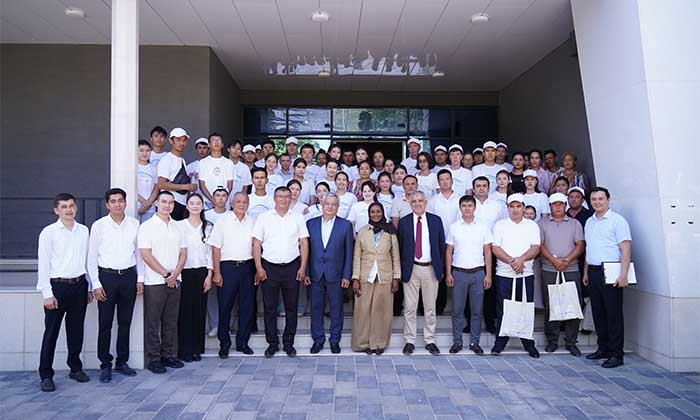
The International Center for Biosaline Agriculture (ICBA), with support from Abu Dhabi Fund for Development (ADFD) and in collaboration with the Agency for Innovative Development under the Ministry of Higher Education, Science and Innovation of the Republic of Uzbekistan, has launched the Farmers’ and Agro-Entrepreneurs Accelerator in Nukus. The one-month program is being implemented under the ADFD-funded project “Development of Sustainable Agricultural Production Systems in Degraded Areas of Karakalpakstan”.
The program, delivered at Youth Technopark in Nukus, will support 200 farmers and agro-entrepreneurs in developing value-added products and strengthening their capabilities in agribusiness management and market access with particular focus on attracting women and young people.
His Excellency Mohamed Saif Al Suwaidi, Director General of ADFD, said: “The launch of this program reflects the Fund’s commitment to maximizing the development impact of its projects by empowering local communities and strengthening their capacity to achieve sustainable economic growth. Our collaboration with the International Center for Biosaline Agriculture and the Agency for Innovative Development demonstrates the importance of partnerships that bring together development finance, scientific expertise and local knowledge. The program aims to support farmers and agro-entrepreneurs in Karakalpakstan develop value-added products and strengthen their access to markets, supporting the sustainability of the agricultural sector and the local economy.”
Dr
Tarifa Alzaabi, Director General of the International Center for Biosaline Agriculture, said: “This program builds on the progress achieved with our partners in Karakalpakstan and marks an important step towards translating advances in agricultural production into sustainable economic opportunities. Our work is guided by an integrated approach that covers the entire agricultural value chain, from production and post-harvest management to processing, marketing and delivery to consumers.”
Dr. Alzaabi added: “Through the program, we are drawing on ICBA’s scientific and applied expertise to equip 200 farmers and agro-entrepreneurs with the knowledge and skills needed to develop high-quality products that meet market requirements. We look forward to seeing participants translate this knowledge into value-added products and scalable enterprises, strengthening their competitiveness and contributing to a more sustainable and climate-resilient agricultural sector in Karakalpakstan.”
Dr. Asror Norov, Acting Director of the Agency for Innovative Development, said: “The program provides a practical pathway that brings together scientific knowledge, local experience and market requirements. Participants will be able to develop their ideas and products, strengthen their business management and marketing capabilities, and build stronger links with stakeholders across agricultural value chains.”
Dr. Norov added: “Our collaboration with ICBA represents an important step in advancing agricultural innovation in Karakalpakstan and drawing on its scientific and applied expertise in agriculture in arid and saline environments. The program will also help expand the participation of women and young people in developing sustainable agribusinesses across the region.”
The program comprises 16 training modules, spanning across four weeks, covering product and value chain development, post-harvest management, agro-processing, food safety and quality standards, packaging and labelling, intellectual property, business planning, financial modelling, branding and market access.
Integrating technical training, practical guidance and business concept development, the program will help participants transform crops and primary agricultural commodities into market-ready products. Participants will also gain an understanding of quality, registration and pricing requirements, sales channels and opportunities for expansion.
The programme builds on the results of the ADFD-funded project in Karakalpakstan, which has supported the adoption of crops adapted to challenging environmental conditions, including sorghum, millet and improved fodder varieties, while advancing sustainable crop, soil and water management practices.
The program’s success will be measured against several indicators, including participant engagement, the quality of the products and business concepts developed, their market readiness, and their potential to generate additional value across the agricultural value chain.