

11
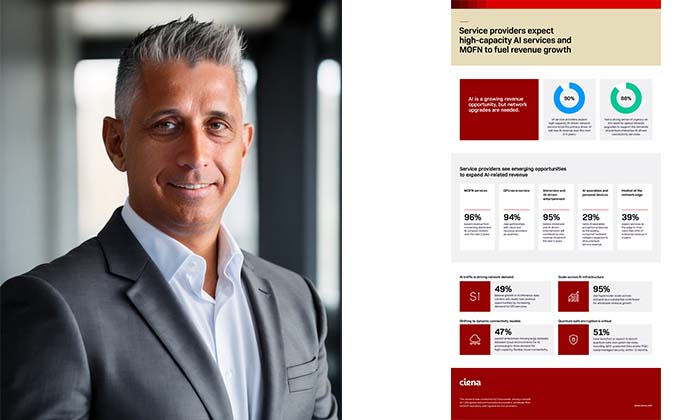
A recent Ciena survey underscores the expected revenue potential of AI-driven networking in the Gulf. In the UAE, 96% of respondents expect high-capacity AI-driven network services – connectivity to AI infrastructure required by enterprises, hyperscalers, and neoscalers – to drive revenue growth over the next three to five years, compared with 90% in Saudi Arabia.
Confidence in managed optical fiber network (MOFN) services is similarly strong in both markets, with 97% of UAE and 96% of Saudi respondents anticipating MOFN to generate revenue from interconnecting distributed AI compute clusters over the next three years.
Across the two markets, service providers believe network upgrades are needed to support AI-driven demands. However, the findings hint at Saudi Arabia taking the preparedness edge by a margin:
· In the UAE, 97% of survey respondents believe optical network upgrades are urgently needed to support premium enterprise AI service level agreements (SLAs), with 56% responding that they are critically urgent.
· In Saudi Arabia, 86% believe optical network upgrades are urgently needed, with 51% stating upgrades are needed immediately and 35% saying they are needed within 12 to 18 months.
The Ciena survey, conducted in collaboration with Censuswide, questioned 100 service provider experts in each of the UAE and Saudi Arabia as part of a wider study spanning 12 countries. It found service providers in both markets see multiple emerging opportunities to expand AI-related revenue streams:
· AI Inference: Growth in AI inference data centers is expected to increase demand for data center interconnect services, cited by 58% of Saudi respondents, above the global average of 49%. In the UAE, just 37% say the same.
· GPU-as-a-Service: Service providers in both markets see opportunity to capture GPU-as-a-service revenue. Strategic partnerships with cloud and neocloud providers are viewed as essential to success by 96% of UAE and 91% of Saudi respondents.
· Connecting AI in Day-to-Day Life: Confidence in AI-driven entertainment as a new revenue stream is strong in both markets, cited by 96% of UAE and 95% of Saudi respondents, in line with the global finding of 95%. The two markets diverge, however, on which consumer hardware category will drive the most premium service revenue.
· Physical AI: Physical AI ecosystems, including industrial robotics and remote-control systems, are expected to account for more than 15% of total enterprise AI revenue within five years by 52% of UAE and 37% of Saudi respondents.
The survey findings also highlight how AI is reshaping service provider priorities in the region, from network performance to cloud connectivity models and security posture. According to the survey:
· Reliability and Consistency: Network consistency, including guaranteed performance stability and low jitter, is the believed to be the leading premium monetization opportunity among Saudi service providers, cited by 42% of respondents, compared with 35% globally. Network consistency, including guaranteed performance stability and low jitter, is the leading premium monetization opportunity among Saudi service providers.
· Scale-Across AI Infrastructure: As power constraints limit data center expansion on a single campus, hyperscalers are scaling compute capacity across distributed locations. This hyperscaler demand is seen as a substantial contributor to wholesale revenue growth by 99% of UAE and 91% of Saudi respondents, both close to the global figure of 95%.
· Multi-Cloud Connectivity: The two markets diverge on how service providers plan to monetize enterprise multi-cloud demand. In Saudi Arabia, multi-cloud connectivity management leads as a revenue driver at 64%, above the global figure of 56%. In the UAE, however, traditional fixed-capacity services remain the leading revenue model at 57%, ahead of multi-cloud connectivity management at 46%, a reversal of the pattern seen globally and in Saudi Arabia.
· Quantum-Safe Encryption and Sovereign Infrastructure: UAE service providers appear further along in commercializing quantum-safe services, with 54% saying they have already launched or expect to launch offerings within 12 months, compared with 38% in Saudi Arabia.
“Globally, service providers are balancing optimism with urgency about AI-driven revenue opportunities,” said Pete Hall, regional managing director for the Middle East and Africa at Ciena. “The survey findings for UAE and Saudi Arabia showed the same optimism, but urgency sits at the center of the conversation. In the UAE, service providers are treating network upgrades and automation as something to act on now, not plan for later. In Saudi Arabia, service providers are also focused on AI inference, service reliability, and sovereign infrastructure requirements.”
Methodology
The research was conducted by Censuswide, among a sample of 100 UAE and 100 Saudi Arabia Telecommunications Providers, Wholesale Fibre Network Operators, and Regional Service Providers, drawn from a global study of more than 1,200 respondents across 12 countries. UAE data was collected between July 13 and July 22, 2026, and Saudi Arabia data was collected between July 13 and July 23, 2026. Censuswide is a member of the Market Research Society (MRS) and the British Polling Council (BPC), a signatory of the Global Data Quality Pledge, and adheres to the MRS Code of Conduct and ESOMAR principles.