

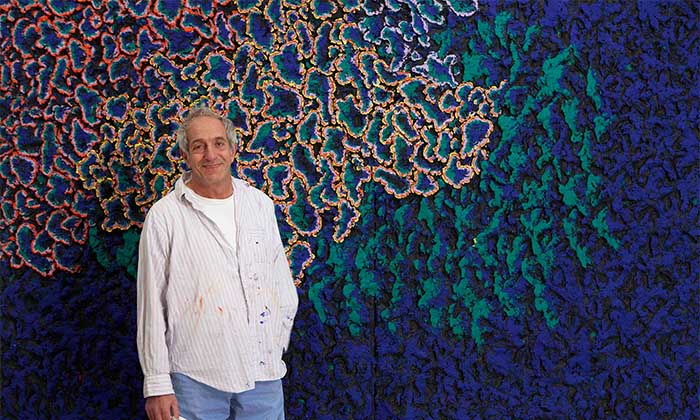
During a press conference held at the Lebanese National Library, in the presence of the Minister of Culture, Dr. Ghassan Salamé, the Commissioner and Curator of the Pavilion of Lebanon, Dr. Nada Ghandour, presented “Don’t Get Me Wrong”, an immersive installation by Nabil Nahas, who represents Lebanon at the 61st International Art Exhibition – La Biennale di Venezia.
The Pavilion of Lebanon at Biennale Arte 2026, held under the auspices of the Ministry of Culture and organized by the Lebanese Visual Art Association (LVAA), will take place from May 9 to November 22, 2026.
During his speech, Minister Dr. Ghassan Salamé stated: « I want to congratulate my friend Nabil Nahas on his selection to represent Lebanon at the 61st International Art Exhibition – La Biennale di Venezia. This choice does not concern Nabil alone; it also reflects an appreciation of Lebanese creators who move between inside and outside the country, while their attachment to their homeland remains steadfast. Today, we are in a phase of rebuilding the world’s trust in Lebanon, and I believe that creators play a fundamental role in restoring this confidence, also by highlighting one of Lebanon’s essential qualities: being an inexhaustible source of creativity, innovation, and achievement.
It gives me great pleasure to speak today, precisely one day after the ministry launched its five-year creative industries strategy. This is part of that effort, in the sense that strengthening confidence in the Lebanese state and nation also comes through enhancing Lebanon’s image abroad. Accordingly, the ministry considers it its duty, within its capabilities, to contribute to reinforcing that image. For this reason, we are proud of Lebanon’s presence at Biennale Arte 2026. I also thank the Lebanese Association for Visual Arts for their dedication and for the work they have carried out this year and in previous years to affirm Lebanon’s presence on the international stage. »
Dr
Nada Ghandour emphasized: “In 2026, the Pavilion of Lebanon will stand as a celebration of creativity and fraternity. At a time of global uncertainty and instability, it is essential that nations promote voices other than violence. Space must be given to the imaginative and conciliatory power of artists who express a shared, open and free language, because art has the ability to create bonds that transcend geographical, cultural, historical, and ideological boundaries”.
The artist Nabil Nahas explores the relationship between man, nature, and the cosmos in this immersive work, offering a visual and spiritual experience, which transforms the spectacular into a vehicle for introspection.
Reflecting Lebanon’s fluid and multicultural identity, the Pavilion celebrates unity in diversity and the beauty of contradictions, in line with the artistic research Nabil Nahas has been pursuing over several decades, travelling between Lebanon and the United States.
Spanning forty-five linear metres within the Arsenale, the installation consists of twenty-six acrylic-on-canvas panels. Each panel rises three metres high and is arranged side by side to form a monumental, enveloping frieze that invites visitors to navigate within it. Inspired by Persian miniatures, the installation resists linear narrative and fixed interpretation, offering instead an experience to be lived rather than an image to be deciphered.
The compositions feature a rich, complex visual language, where different types of geometric abstractions, inspired by Islamic and Western traditions, meet figuration and fractal patterns, forming an unexpected continuum.
The geometric forms evoke the mathematical structure of the cosmic order: a unified ensemble, the universe is composed of the infinitely small and the infinitely large. Certain patterns repeat across all scales, in both the animal kingdom and nature, reminding us that humanity is part of an infinite whole. Likewise, the spiral — a symbol of infinity drawn from Sufi mysticism—acts as a hypnotic force on the mind, guiding an intimate, inward journey.
The tree motif, central to Nabil Nahas’s work, embodies the tension between rootedness and transcendence through tree species found in biblical texts, including the cedar—the mythical tree of the Lebanese mountains, symbolizing endurance and strength—and the olive, an allegory of life.
Through this installation, Nabil Nahas celebrates Lebanon as a land of confluences, where communities rooted for centuries have shaped a plural identity. Rather than a mere collection of disjointed fragments, this identity is seen and represented as a living, coherent entity, constantly evolving and perpetually in motion.
The history of Lebanon is that of an extraordinary crossroads, a place where great civilizations have emerged, succeeded one another, and intersected. In Nabil Nahas’s work, Greco-Roman, Judeo-Christian, Byzantine, and Islamic influences reflect the country’s layered, centuries-old heritage.
Don’t Get Me Wrong can be read as a sensitive topography of the country. For the artist, the memory of his homeland is a polyphony, composed of echoes and resonances that extend into his own life: after growing up between Lebanon and Cairo, Nahas settled in New York. Following an 18-year absence, he returned to Lebanon for a brief visit after the civil war—a visit that marked the beginning of increasingly frequent returns.
Biography of Nabil Nahas:
A major figure in the contemporary art scene, Nabil Nahas is a Lebanese-American painter born in Beirut in 1949. He settled in the United States in 1969, where he earned a BFA from Louisiana State University, followed by an MFA from Yale University in 1972. He lives and works between Beirut and New York.
Nabil Nahas’s works are featured in the collections of major institutions such as the British Museum (London, United Kingdom), Tate Modern (London, United Kingdom), the High Museum of Art (Atlanta, United States), the Metropolitan Museum of Art (New York, United States), the Voorhees Zimmerli Museum at Rutgers University (New Jersey, United States), the Colby Museum of Art (Waterville, Maine, United States), the Pennsylvania Academy of the Fine Arts (Pennsylvania, United States), the Museum of Fine Arts (Boston, United States), the Flint Institute of Arts (Michigan, United States), the University of Michigan Museum of Art (UMMA, United States), the Barjeel Art Foundation (Sharjah, UAE), Mathaf: Arab Museum of Modern Art (Doha, Qatar), the Ramzi & Saeda Dalloul Art Foundation (Beirut, Lebanon), and the Guggenheim Abu Dhabi (UAE).
Nabil Nahas is represented by: Saleh Barakat Gallery (Beirut), Lawrie Shabibi (Dubai), Tanit Gallery (Munich), Ben Brown Fine Arts (London, Hong Kong).