

Al-Futtaim has released a major new white paper, Rethinking Urbanisation & Mobility in the GCC, calling for a shift from fragmented development models to a unified, systems-based approach that integrates transport, energy, housing, land use, and digital infrastructure. Developed in partnership <a href="https://menainsights.com/al-masraf-and-commerzbank-sign-memorandum-of-understanding-with-to-strengthen-cross-border-banking-collaboration/”>with UN-Habitat, Arup, Arab Urban Development Institute (AUDI), Emirates Center for Mobility Research (ECMR) at UAE University, and with inputs from Systemiq, the white paper charts a 10-year roadmap designed to help GCC cities manage rapid growth while ensuring long-term resilience, sustainability, and liveability.
As GCC cities experience unprecedented population expansion, climate pressures, and rising mobility demand, the white paper argues that traditional planning approaches can no longer keep pace. Instead, it calls for governments, developers, and private-sector partners to embed mobility at the heart of urban design; adopt data-driven planning; and coordinate infrastructure, land use, and investment strategies from the outset.
A core feature of the paper is a proposed systems-based planning model, one that treats the city as an interconnected whole rather than isolated sectors. This includes aligning infrastructure upgrades with mobility needs, integrating development timelines across government agencies, and ensuring that housing, public transport, and services evolve together rather than independently.
“Cities in the GCC are at a pivotal moment,” said Ellora-Julie Parekh, Chief Sustainability Officer, Al-Futtaim. “The region is seeing unprecedented population growth, driven by economic prosperity. This will require a fundamentally new urban development logic, one that connects systems much more efficiently to enable future place-making. This white paper presents a shared vision for how governments, businesses, and communities can jointly accelerate progress, shifting from ambition to coordinated, system-wide action.”
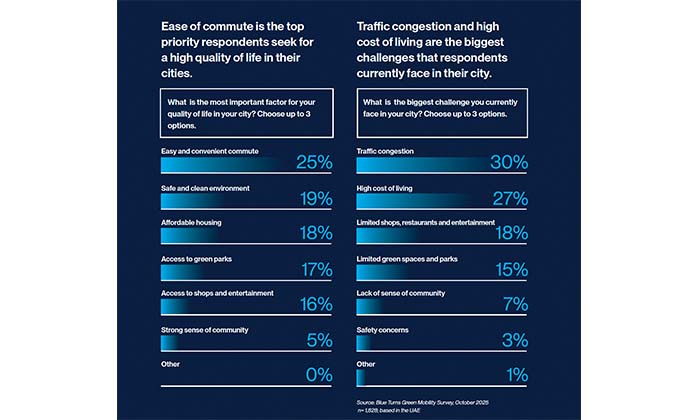
The white paper also incorporates findings from Al-Futtaim’s “Blue Turns Green – Mobility” survey, capturing the views of 1,828 UAE residents. The results highlight strong public expectations for better-connected, time-efficient cities: ease of commute emerged as the top quality-of-life priority, while congestion and cost of living ranked as the most pressing urban challenges. These insights reinforce the need for structural, long-term reform rather than incremental changes.
Throughout the development of the white paper, partner organisations reinforced the importance of integrated, collaborative planning.
Dr. Ayman El-Hefnawi, GCC Representative, Regional Office of Arab States, UN-Habitat, noted: “UN-Habitat champions the principles of sustainable urban development globally. This white paper provides granular insight into the GCC context and can inform best practices worldwide, helping cities grow more inclusive, resilient, and environmentally sound.”
Ghaith Tibi, Middle East Sustainability & Climate Leader, Arup Middle East, said: “Urban transformation requires collaboration across disciplines. This partnership demonstrates how design, engineering, and policy can converge to deliver adaptable, human-scale cities ready for the future.”
Julia Okatz, Director, Systemiq, added: “The GCC’s strong investment capacity and forward-looking leadership make it uniquely positioned to leapfrog traditional development models. By aligning climate ambition with systems-level design, the region can define what sustainable growth looks like over the coming decades.”
Dr. Anas Almughairy, Director General, Arab Urban Development Institute (AUDI), commented: “Arab cities are at a crossroads, balancing rapid development with climate resilience. The only viable path forward is integrated planning that harmonises mobility, housing, and energy to improve quality of life for all citizens.”
Dr. Hamad Al Jassmi, Professor of Civil & Environmental Engineering and Director, Emirates Center for Mobility Research (ECMR) at UAE University, noted: “Building sustainable cities starts with evidence. Our collaboration ensures that academic research informs real-world planning and policymaking, linking data and innovation to shape urban systems that genuinely work for people.”
A 10-Year Roadmap for GCC Cities
The white paper proposes a phased roadmap that translates high-level ambition into practical action:
- Quick wins (1–2 years): Deliver visible improvements to urban life such as shaded pedestrian routes, more walkable districts, and better first/last-mile connectivity; optimise existing public transport services; and embed sustainability requirements into new community developments.
- Medium-term (3–5 years): Expand mass transit networks, introduce comprehensive frameworks for electric and hybrid mobility, establish city-level data ecosystems, and pilot integrated mobility and urban development models in smaller cities or economic zones.
- Long-term (10 years): Position mobility as a core pillar of governance; adopt fully integrated, cross-sector planning systems; operationalise advanced decision-support hubs; and align development incentives with environmental, social, and liveability outcomes.
These recommendations aim to ensure that GCC cities can meet fast-changing demands while enhancing affordability, accessibility, and resilience for residents.
The white paper calls for closer public–private collaboration, agile regulatory frameworks, and interoperable data systems to accelerate progress. It argues that with unified planning and coordinated investment, GCC cities could become global benchmarks for sustainable, future-ready urban development.
The white paper calls for an ecosystem-wide response that connects policy, innovation, and behavioural change, advocating for closer public–private collaboration, agile regulatory frameworks, and data-driven governance.
Ultimately, Rethinking Urbanisation & Mobility in the GCC charts a decade-long vision for cities that are not only technologically advanced, but also inclusive, connected, and built for the pace of people.
Explore findings from the full white paper here https://www.alfuttaim.com/articles/rethinking-urbanisation-mobility-in-the-gcc/